
Tyler County Warrant Checks
Tyler County publishes no countywide warrant lookup, so the search begins with the court that handled the matter. The paper you hold tells you where to go. A citation, notice, or case file names the issuing court, and that office answers the warrant question directly. Felony cases sit with the District Clerk and the 1A or 88th District Court. County criminal misdemeanors belong to the County Clerk and County Court, while Justice of the Peace Precincts 1 through 4 each keep their own Class C files. Woodville and Ivanhoe run separate municipal courts, so a city ticket stays in that city's records. Before you call, gather the full legal name, date of birth, and any case or citation number. If the clerk cannot confirm a warrant by phone, ask which office holds the file and whether a written request is required. The Tyler County Sheriff's non-emergency line covers sheriff-held process, but it never replaces a check with the issuing court itself.
- Read the paperwork and identify the court, city, precinct, and cause or citation number.
- Call that clerk or court coordinator with the person's full name and date of birth; ask about active process and the next required step.
- For a sheriff-held record, call the Sheriff's Office at its published non-emergency number.
- If phone confirmation is not enough, request existing records in writing through the county's Public Information Act instructions.
- Before a payment or appearance, ask the issuing court how to resolve the case and confirm when any status change will be recorded.
The Tyler County File Split
The case type tells you which office keeps the file. The District Clerk holds district criminal and felony records, and the County Clerk keeps County Court misdemeanors. A justice-court citation stays with its JP precinct. A Woodville or Ivanhoe ticket belongs to that city's municipal court. The offices sit in and around Woodville, yet none of them share a single warrant list. The county directory can help you find the right court, but a directory is not a warrant result. A real Tyler County warrant search means contacting the likely issuing court and using the sheriff as a separate confirmation route. The county courthouse and department pages lay out the full office network, since the workflow follows the case file rather than one database.

The Tyler County homepage points to the courthouse hub. It is not a warrant roster and never replaces the clerk's case file.
Warrants in Tyler County: The Main Types
Different court events create different papers. An arrest warrant, a missed-date capias, and an unpaid-fine capias pro fine do not share one public lookup or one fix. Tyler County dockets carry several status terms. Ask the clerk to name the exact paper in your case.
| Warrant Type | How It Arises | Who Issues It |
|---|---|---|
| Arrest warrant | A sworn complaint or affidavit presents probable cause. | Magistrate or judge |
| Bench warrant / FTA capias | A person misses a required court setting after a case begins. | Judge of the issuing court |
| Capias pro fine | A judgment or fine remains unsatisfied in a justice or municipal case. | Justice or municipal court |
| Search warrant | Authorizes a search based on a sworn probable-cause showing. | Magistrate; access may be limited |
What FTA Capias Means Here
Tyler County's 2025 County Court dockets use the label “FTA capias” for process tied to a failure to appear. A capias follows an already-filed case. It sends an officer to bring the person before the court. It is not a complaint-based arrest warrant.
- FTA
- Failure to appear for a required court setting.
- Capias
- A court writ directing an officer to bring a person before the issuing court.
- Capias pro fine
- Process tied to an unpaid fine or judgment, often in a JP or city case.
- Recalled
- The court has withdrawn that process; the underlying case may still be open.
Tyler County Warrant Records: What They Show
Official docket PDFs show a case number, court, setting, offense class, and action history. A capias can be issued, served, recalled, or reset. Tyler County posts no county bond schedule or standard warrant-number format. Use the case number when you call.
| Case reference | Cause number varies by court |
|---|---|
| Subject | Name and other case details can appear in court records; personal docket data is not reproduced here. |
| Charge / offense | Offense description and class may appear in the court file. |
| Issuing court | District, County, JP, or municipal court named on the case. |
| Bond | Ask the court; a countywide bond schedule was not located. |
| Action | Issued, returned served, recalled, or reset are separate docket events. |
Four JPs, Two City Courts
Four JP precincts handle Class C and traffic cases. The state directory lists two municipal courts: Woodville and Ivanhoe. That count maps court routes, not warrant volume. The Tyler County JP page lists separate rooms at 203 West Dogwood, so call the precinct before you go.
The Tyler County Justice Courts page is the official spot for precinct contacts and forms.
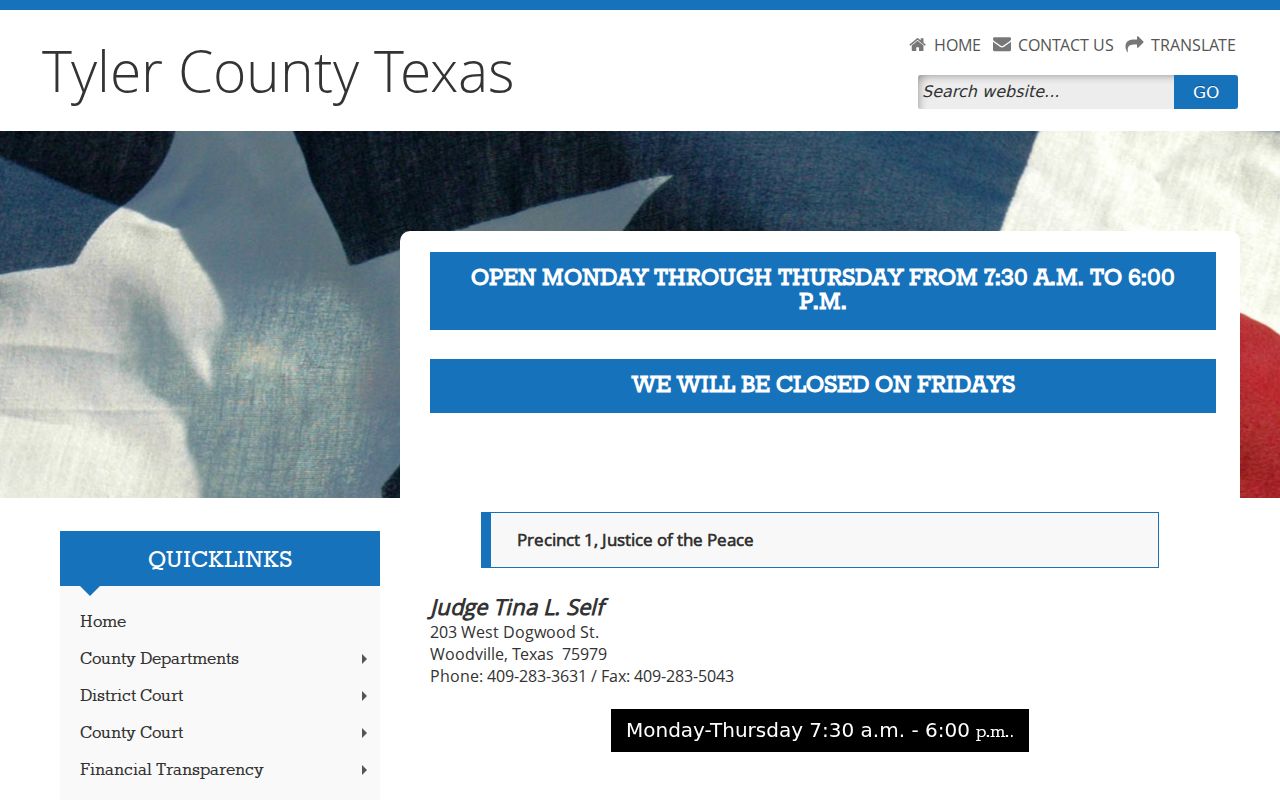
The page groups four Tyler County courts together. Each one still keeps its own cases and warrant status.
Tyler County Warrants: Who Issues, Who Serves
Judges and magistrates issue the paper. The sheriff, constables, city police, and other peace officers may execute it in Tyler County. No table maps warrant types to serving units. The sheriff's office is at 702 N. Magnolia in Woodville. Its page lists a non-emergency line and a separate corrections number. No warrant desk, online list, or walk-in hours appear. Call before appearing if deputies may hold it. For court status, use the clerk or coordinator named on the case, and remember that a corrections call is for custody routing unless staff directs otherwise.
Tyler County Sheriff's Office
702 N. Magnolia
Woodville, TX 75979
(409) 283-2172 non-emergency
A Docket Is Not a Warrant List
Tyler County posts some date-specific FTA dockets. Each calendar lists cases set for a session and can include issued, recalled, served, or reset actions. The July 8, 2025 docket listed 29 cases. That figure is not a count of active warrants. A docket can be old, partial, or limited to one court. The sheriff publishes no roster, search fields, update schedule, or countywide active-warrant total. A name missing from a PDF proves nothing. Confirm with the court that holds the case, then ask the sheriff whether its records show a separate Tyler County entry.
No County Bond Schedule Is Posted
Tyler County posts no bond schedule, jail bond window, or accepted payment methods for a warrant. Ask the issuing court or an attorney instead. Find out whether a bond applies, where it can be posted, and whether it leads to release pending a new setting. Skip third-party amounts.
Handling a Tyler County Warrant
Call the issuing court first. Ask what the warrant is called and what step clears it. A lawyer can seek a reset, a recall, a voluntary appearance, or bond before anyone walks into an office in Tyler County. There is no public surrender procedure or bond schedule here, so the court's own instructions control everything.
Important: Confirm the issuing court and safe procedure before appearing; Woodville's arrival policy applies only to Woodville Municipal Court warrants.
Why OmniBase Is Not a Warrant Search
Texas DPS runs a Failure to Appear / Failure to Pay Program that can block license renewal after a court reports an unpaid citation or a missed appearance. It is not a warrant database. DPS license specialists will not tell you whether a warrant exists. A hold on your license hints at a court matter, nothing more. It will not name the warrant type, the bond, or where the case stands now. Check the DPS OmniBase contact for a reported citation, then confirm the case with the Tyler County court that reported it.
Warrant Record Access Under Texas Law
The Texas Public Information Act governs releasable government records, though court files also answer to court rules and confidentiality laws. Once executed, an arrest warrant and its supporting affidavit generally open to the public under Code of Criminal Procedure Art. 15.26. A child's arrest warrant and supporting papers stay confidential under Family Code §58.010. Tyler County offices may withhold sealed or otherwise protected material.
Key Rules:
Texas Government Code Chapter 552 - request existing public information in writing; exceptions still apply.
Texas Code of Criminal Procedure Art. 15.26 - executed arrest warrants and affidavits are public, subject to other limits.
Texas Family Code §58.010 - a child's arrest warrant and supporting complaint or affidavit are confidential.
Request Existing Records in Writing
Tyler County's Open Records page requires any request to be in writing and to ask for records that already exist. For sheriff-held material, the page routes requests to publicrecords@co.tyler.tx.us. Name the court or agency, give your own name and date of birth, add the case number if you have one, and describe the specific record you want. If a file holds protected material, ask for the releasable portions. Don't ask the county to research a legal issue or build a new report; that isn't a records request. Even a proper written request can be delayed, redacted, or denied under an exception. The county page explains routing and recommends keeping proof of delivery.
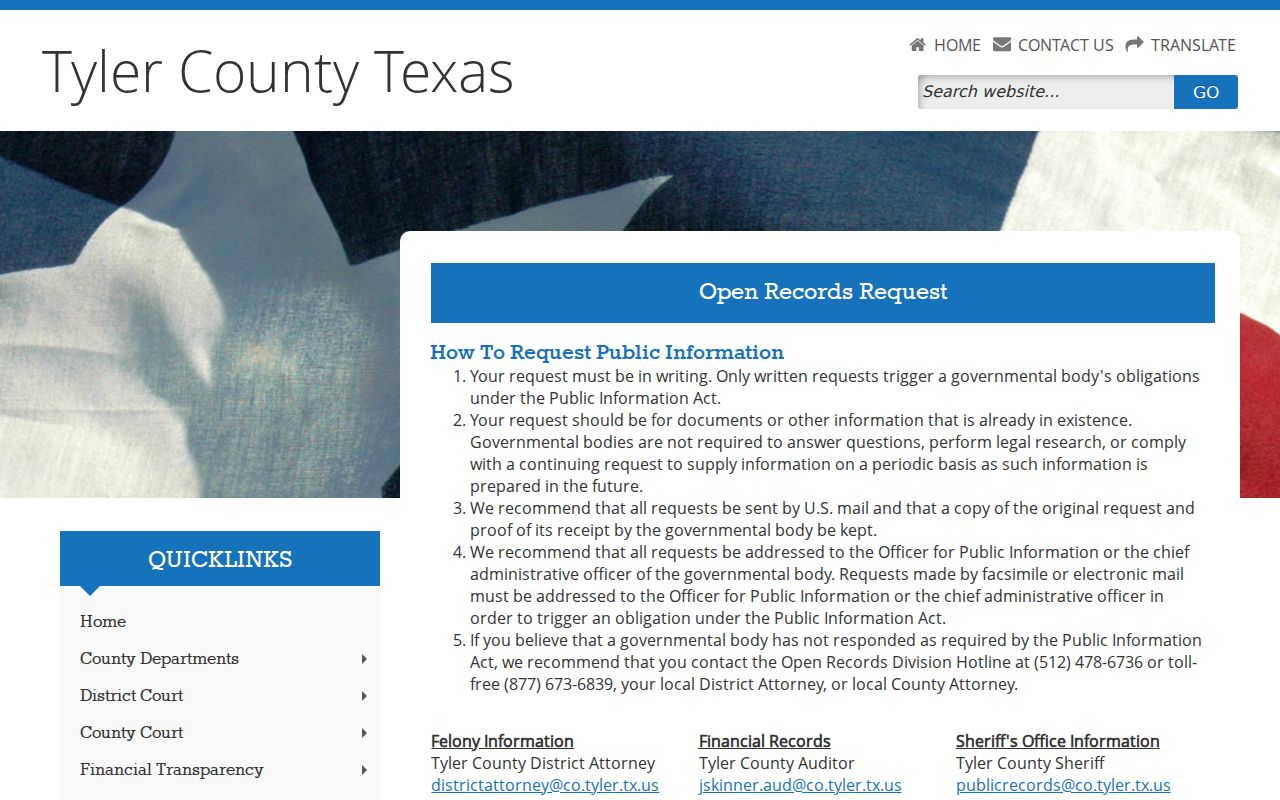
The official instructions tell you where a written Texas Public Information Act request goes. They do not promise a full list of active Tyler County warrants.
City Warrant Records in Tyler County
Four incorporated places sit in Tyler County by the 2020 Census, so four city pages follow. Woodville and Ivanhoe both have municipal courts. Colmesneil and Chester publish no municipal court entry or warrant portal; a citation holder should read the issuing court printed on the paper and call that office.
Woodville Warrants
2,403 residents · city court publishes payment and warrant-resolution instructions
Ivanhoe Warrants
1,327 residents · municipal court serves by appointment
Colmesneil Warrants
542 residents · confirm the court printed on the citation
Chester Warrants
270 residents · use the citation to identify the issuing court