
How Bench Warrants Work in Tyler County
A bench warrant is a judge's order tied to a court obligation. Tyler County FTA dockets use the terms “failure to appear” and “FTA capias” after missed settings. A judge may also issue process for contempt or a violation of an order, but the remedy depends on the case and court.
An unpaid fine follows a different path. In a JP or municipal case, a capias pro fine is tied to a judgment that remains unsatisfied. Ask the clerk which label appears before assuming that every missed date or unpaid amount has the same consequence.
Tyler County FTA Capias Docket Terms
Tyler County's 2025 County Court FTA calendars show a sequence of actions rather than a public warrant roster. Entries can record an FTA capias issued, returned served, recalled, or a hearing reset. The clerk can say what the latest event means in a particular file.
One published July 8, 2025 docket contained 29 scheduled cases. It is not the county's total outstanding-warrant count. A docket captures a date and a court, while a current status question belongs with the clerk who holds the case.
Use the County Court criminal-misdemeanor contact page for misdemeanor routing.
Bench Warrant Issuance in Tyler County
After a missed setting, the court may note the failure and issue an FTA capias or bench warrant. The order directs an officer to bring the person before the issuing court. Tyler County sources do not publish one common notice period, grace window, or online update schedule for all courts.
The process remains tied to the court file. A district capias goes through the district court and clerk; a county misdemeanor is with County Court; JP and municipal courts keep their own Class C process. No public Texas-wide warrant search is available to residents.
Texas Code of Criminal Procedure Chapter 43 contains capias issuance and recall provisions.
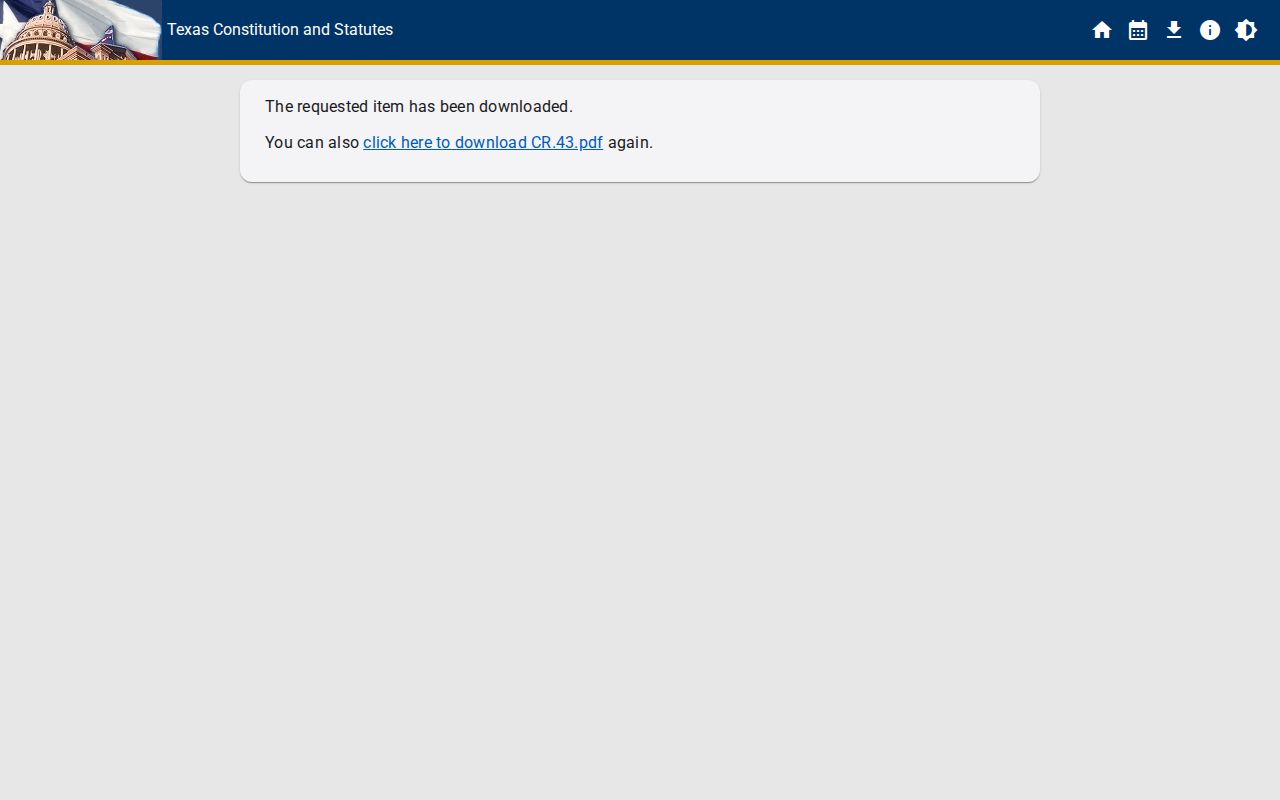
Ask the clerk which rule and court order applies to the specific case.
Four Tyler County JP Bench Courts
Each of Tyler County's four JP precincts handles its own justice-court and Class C matters. The first three offices use 203 West Dogwood Street in Woodville, with Precincts 2 and 3 in Rooms 302 and 303. Precinct 4 uses Room 304 and also lists a Fred mailing address.
Precinct 1 answers at (409) 283-3631; Precincts 2 and 3 share (409) 283-6320; Precinct 4 lists (409) 429-9500. Call the named court before travel so a citation does not send you to the wrong room.
The official Tyler County JP page lists the precinct contacts.
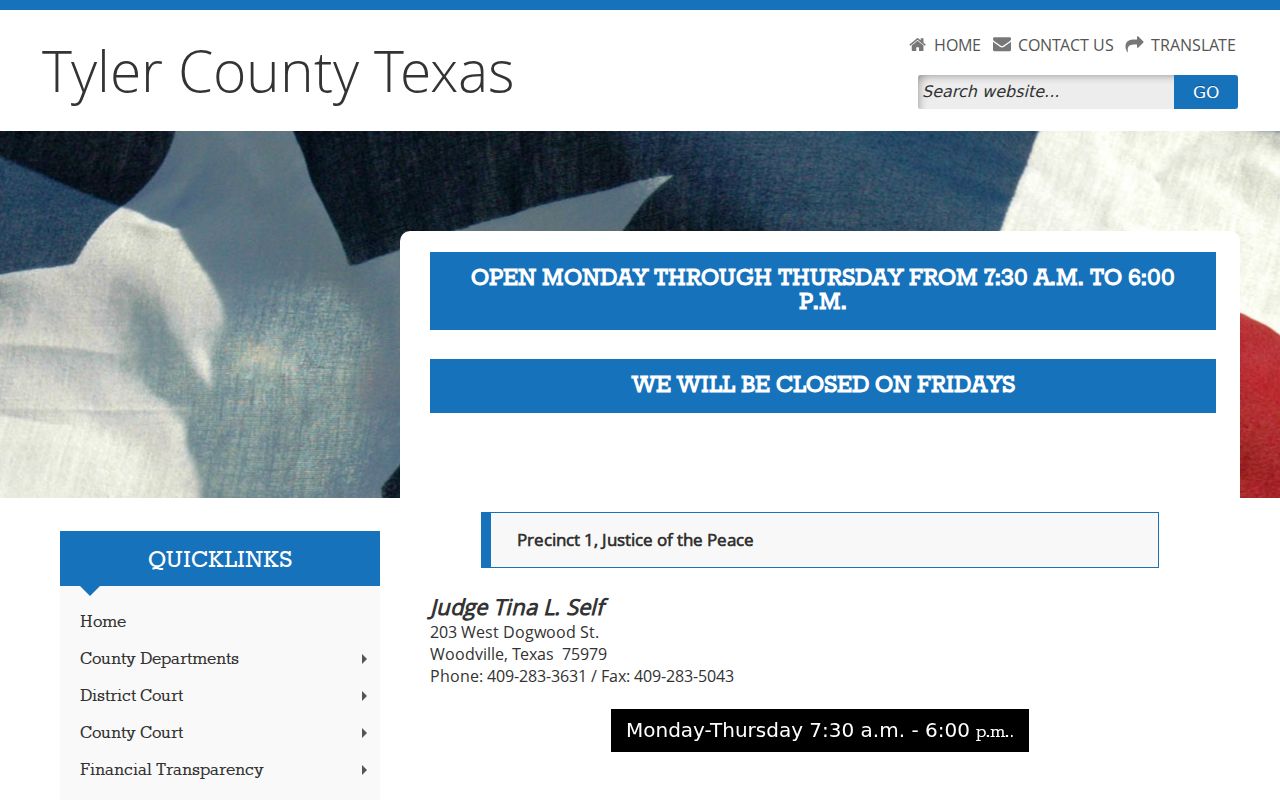
The county JP page lists each precinct’s address, phone, and court resources.
How Bench and Arrest Warrants Differ
A bench warrant or FTA capias responds to an event in an existing case, such as a missed setting. An arrest warrant follows a sworn complaint or affidavit and a probable-cause review. A capias pro fine is tied to a judgment. The distinction points to different court files and different ways to ask for relief.
| Feature | Bench Warrant | Arrest Warrant |
|---|---|---|
| Trigger | Missed setting, contempt, or case obligation | Sworn complaint and probable cause |
| Who issues it | Judge of the court handling the case | Magistrate or judge |
| Case posture | Usually an existing case | May begin the arrest process before trial |
| Next step | Ask the issuing court about reset, recall, or payment | Ask counsel and the court about appearance and bond |
Woodville Safe Arrival Is City Only
Woodville Municipal Court says a person who comes to address a warrant issued by that court will not be arrested on that Woodville warrant at the court. The FAQ also warns that arrest could occur at another time or place. It is a local municipal-court policy, not a countywide promise.
Do not apply that statement to a JP, County Court, district, sheriff, or Ivanhoe warrant. Call the issuing court first and ask what the appearance entails.
The Woodville FAQ sets this city-only arrival rule.
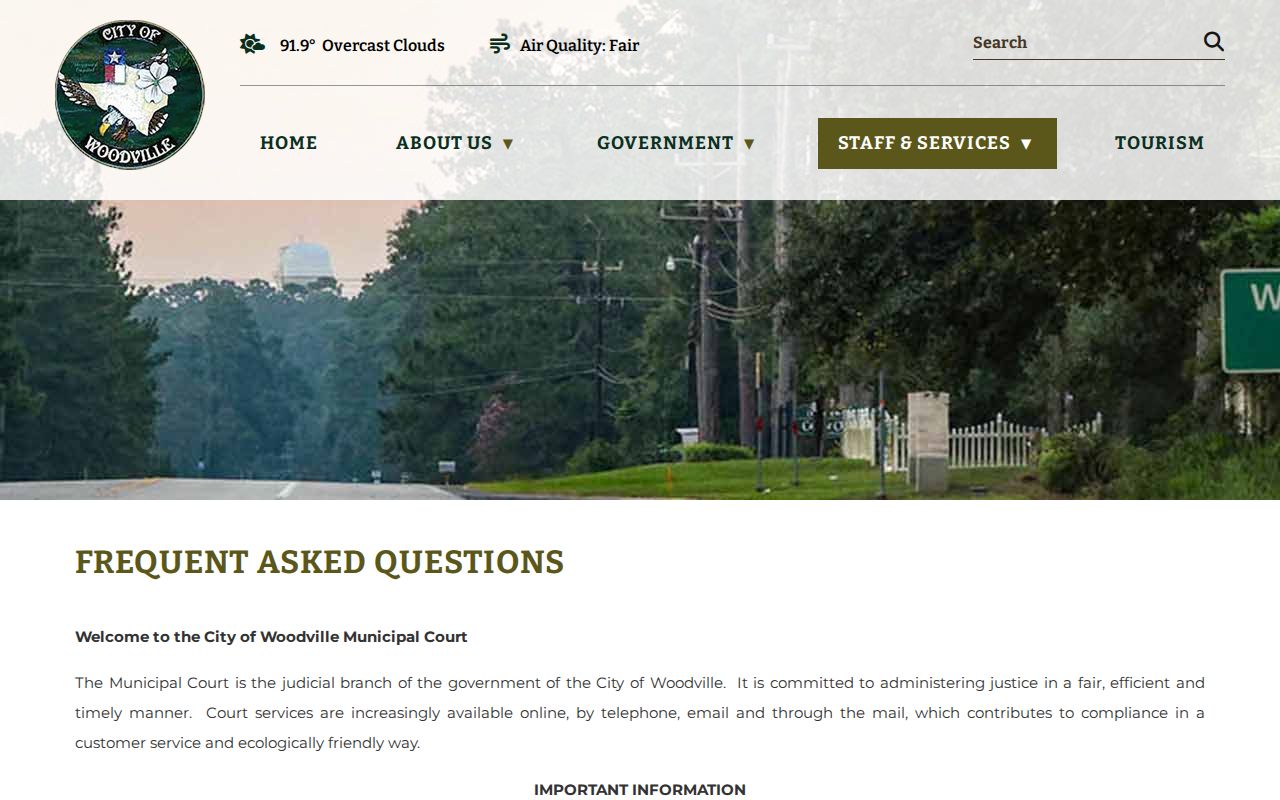
The official FAQ makes the policy boundary clear and does not extend it to other courts.
Clearing a Bench Warrant in Tyler County
Start by asking the clerk to identify the exact process and the court that issued it. Tyler County has no published recall form, filing fee, walk-in warrant docket, or countywide surrender window. A lawyer can contact the court about a reset or motion to recall or quash; the judge decides the request.
- Call the issuing court and ask whether its record shows a bench warrant, FTA capias, or capias pro fine.
- Ask about the next hearing, a reset, a lawyer-assisted recall request, or any payment due.
- For an unpaid JP or city judgment, ask about hardship review, payment, or community service before choosing a route.
- Keep the order or receipt and confirm that the warrant status changed with the court and sheriff.
Caution: A recall can end the warrant without dismissing the case; confirm the next court date and any remaining order.
Hardship Hearing Before a Tyler County Capias
Current Code of Criminal Procedure Art. 45A.259 addresses a capias pro fine when a justice or municipal judgment is not satisfied. Before issuing one for failure to meet the judgment's terms, the court must use the statutory undue-hardship process. The judge can consider ways to satisfy the judgment allowed by law.
Ask the JP or municipal clerk how to request the hearing and what documents to bring. A payment plan or hardship route is not an automatic warrant recall; confirm the judge's order and the court's status update.
Consult Chapter 45A of the Texas Code of Criminal Procedure for the current provision.
Chapter 45A is the current justice-court procedure and contains the hardship provision described here.
Tyler County FTA Dockets Are Date-Specific
The county’s published FTA PDFs describe particular court calendars, not an always-current index. A July 8, 2025 docket showed a 29-case total, and other county docket examples use actions such as “FTA capias issued,” “recalled,” and “order resetting hearing.” Those are useful terms to ask about, but the number on one PDF is not a present-day count of active bench warrants.
Ask the clerk whether a later order or return was entered after the docket date. If the case was reset, confirm the new appearance date separately; a reset is not the same as dismissal or an automatic removal of all process.
Tyler County Courts That Issue Bench Warrants
The issuing court controls a bench warrant and decides whether to recall it. District criminal or felony process goes to the 1A or 88th District Court and District Clerk. County criminal misdemeanors go to County Court and the County Clerk. Class C traffic or ordinance matters belong to the JP or city court named on the citation.
Family and child-support cases follow their own court route, often through district or family records and the Attorney General child-support process. A missed jury summons may lead to contempt action under the County Court's notice, but the research did not find a rule that every missed summons automatically becomes an arrest warrant. Confirm the case type before seeking a recall.